TIERA 101: Why a Free Vibration Programme Is Worth Your Time
Ten free courses, 359 lessons, 211 simulators you actually drive — built by the people who build the instruments. What TIERA 101 is, what it honestly is not, and why both plants and universities are using it.
The claim, stated plainly
You have seen a hundred free-course pages, so let us put the claim where you can shoot at it. TIERA 101 is different for one unglamorous reason: it is written by the people who build the measurement chain it teaches — the accelerometers, the DAQs, the fault simulators — and it makes you drive that chain instead of watching it. Ten courses, three tracks, 359 lessons, and 211 interactive simulators the learner operates, delivered on a real LMS at 101.tieraonline.in with progress tracking. All of it free.
And the second half of the claim, which most free courses bury: TIERA 101 is a free introductory primer, not an accredited certification. It is not ISO 18436, not equivalent to Category I–IV, and its hours do not count toward the formal training ISO 18436 requires. We say that on the certificates, not just here. If a course page will not tell you what its credential is not, be suspicious of what it says it is.
Built by the people who build the instruments
- Measurement Setup 101 is a whole course on its own because setup is where real measurements go wrong — Fmax and resolution, mounting, cabling, averaging.
- The material climbs from a washing machine on spin-up and a stone in your shoe to an analyzer's settings screen, on the argument that everyday physics and instrument physics are the same physics.
Most e-learning about vibration is written by e-learning companies. The slides are tidy, the narration is smooth, and the moment the course has to explain why a hand-held reading disagrees with a stud-mounted one, it goes quiet — because nobody on the authoring team has ever mounted an accelerometer. TIERA manufactures accelerometers, DAQ hardware, and machinery fault simulators. The people who wrote Accelerometer & DAQ Selection 101 are the people who argue about mounting resonance and input ranges for a living.
That shows up in what the courses choose to teach. Measurement Setup 101 exists as an entire course because setup is where real measurements go wrong — Fmax and resolution trade-offs, mounting, cabling, averaging — the decisions an instrument forces on you in the first five minutes and a generic syllabus never mentions. The programme climbs from a washing machine shuddering on spin-up (that is a critical speed), a stone in your shoe (that is a bearing defect impact), wagon wheels spinning backwards on film (that is aliasing) — up to the settings screen of a real analyzer, because everyday physics and instrument physics are the same physics.
211 simulators: you drive, you do not watch
- 211 of the 359 lessons put a control under the learner's hand — move it and the mathematics responds, rather than a recording of someone else moving it.
- A learner who has caused leakage a dozen times and then fixed it picks the right window on a real analyzer without thinking about it. That is the specific difference the simulators are there to make.
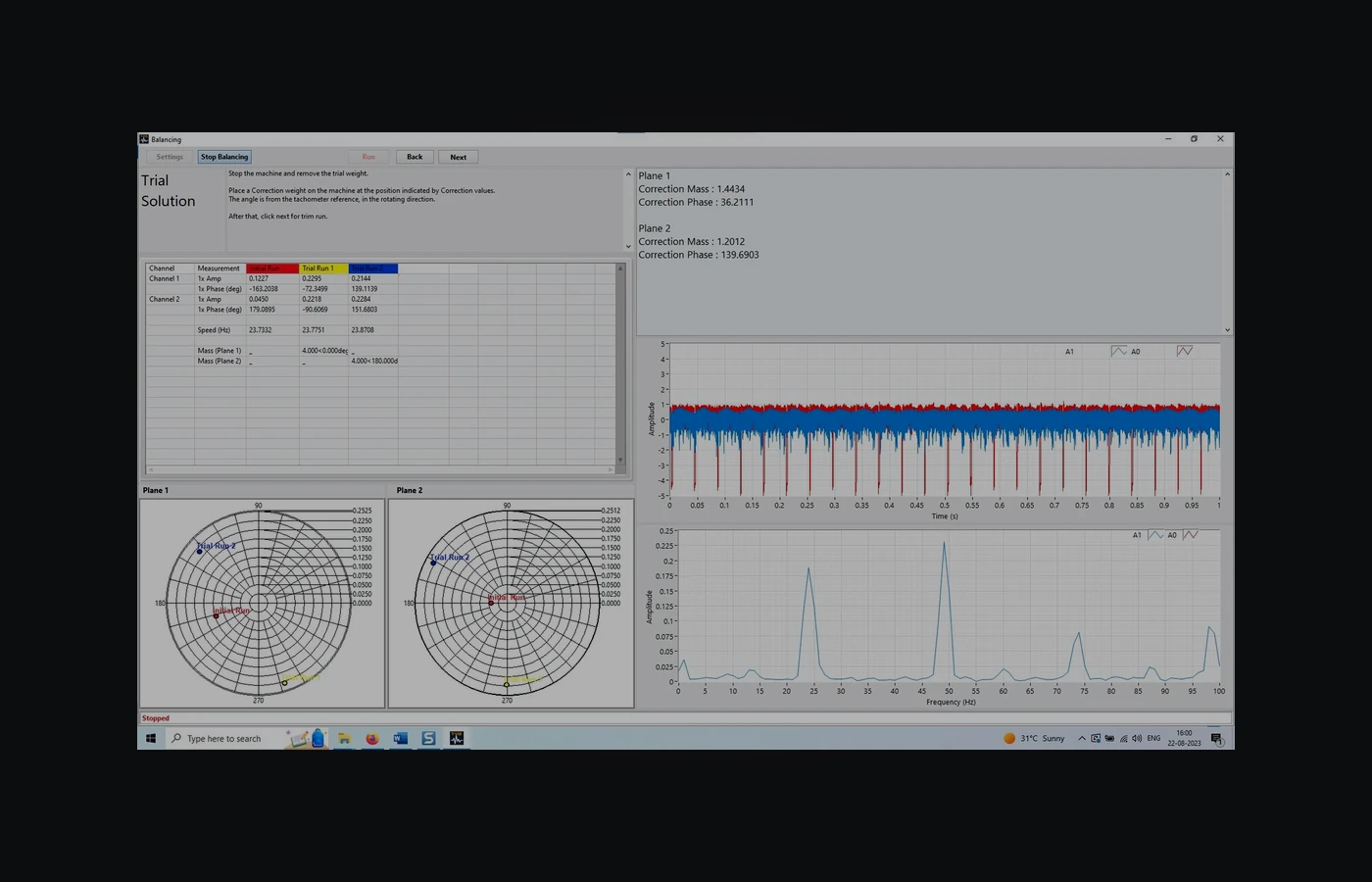
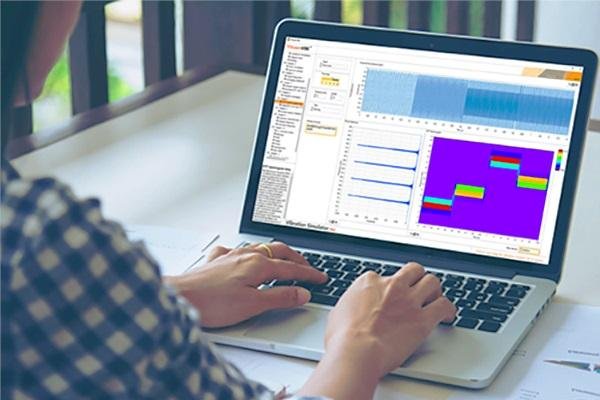
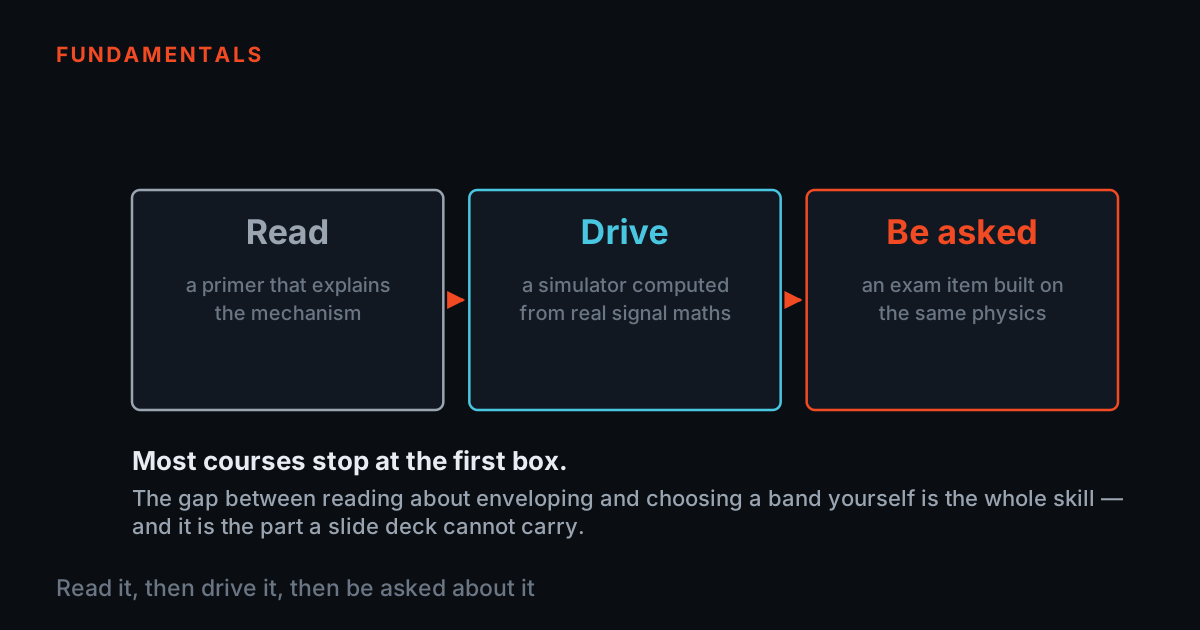
The core teaching decision in TIERA 101 is that understanding comes from operating things. Of the 359 lessons, 211 carry an interactive simulator: set an Fmax and watch the resolution trade away; switch a Hanning window to rectangular and watch leakage skirts grow around the peak; push a rotor through its critical speed and feel the phase flip; switch on an envelope filter and watch bearing tones stand up out of a noise floor that hid them. These are not videos of someone else doing it — the learner moves the control and the mathematics responds.
This matters because vibration analysis is a sequence of instrument decisions, and decisions are only learned by making them and seeing consequences. A learner who has watched a leakage animation can define leakage; a learner who has caused leakage twelve times, then fixed it, will pick the right window on a real analyzer without thinking. That second person is the one the programme is trying to produce.
Three tracks, and none of them is locked
The programme is organised as a ladder — Vibration Foundations, Machinery Diagnostics, Advanced Vibration & CM — but the ladder is not gated. All three tracks are open from day one, in any order. A noise engineer can walk straight into Acoustics & Noise 101; a maintenance technician with a screaming pump can start at Machinery Fault Diagnosis 101 and backfill the signal theory later. The sequence is a recommendation for beginners, not a lock, because adults arrive with different problems and gating them behind a syllabus they already know is how free courses lose people.
Each course ends in an exam — 25 questions, 90% to pass, two attempts — for a course-completion certificate. Each track offers an optional badge exam: 50 questions, 90%, two attempts, 60 minutes. Pass it and you hold a digital badge — Vibration Measurement Analyst, Machinery Diagnostics Analyst, or Advanced Vibration & CM Analyst — issued and verifiable at certify.tieraonline.in, shareable to LinkedIn. A 90% bar with two attempts is deliberately strict for a free course: a credential you cannot fail is not a credential.
What the credential means — and what it does not
Here is the honest hierarchy. The course certificate marks a step: you studied the material and passed a 90% exam. The badge is stronger: a timed, broader exam, and the result is externally verifiable — anyone can check it at certify.tieraonline.in rather than taking a PDF's word for it. Neither is ISO 18436 certification, and TIERA prints that plainly instead of hoping you will not ask. No invented accreditation, no 'industry-recognised' hand-waving, no claim that 18 hours of primer equals a Category rating that formally requires documented training and experience.
When you need the formal credential, that path exists and is separate: TCAT, TIERA's Category I–IV analyst training programme, with proctored examinations at exams.tieraonline.in — details on our services page. TIERA 101 is the free ground floor that tells you, before anyone pays for a seat, whether this discipline is for you and whether your people are ready for it. A training programme that is honest about its own ceiling is rarer than it should be; we think it is also better marketing than pretending.
What a plant does with it
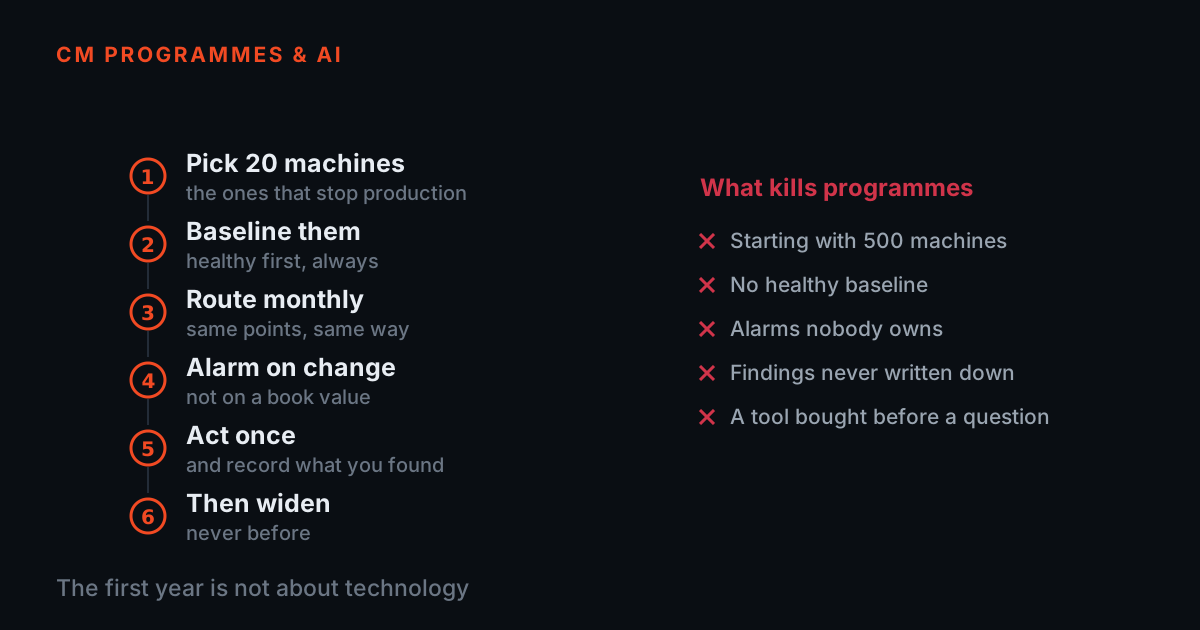
- Condition-monitoring programmes usually die on vocabulary rather than on data: when '1×', 'BPFO' and 'envelope' mean something to one person and nothing to the rest, a flagged reading never turns into a work order.
- It also works as a screen before paid seats — put people through the free primer first and spend the training budget on the ones who finish it hungry.
The cheapest use is onboarding: a new maintenance technician works through Vibration 101 and Machinery Fault Diagnosis 101 in their first weeks, and arrives at their first route knowing what a spectrum is and why the 1× peak matters. The most valuable use is vocabulary: condition-monitoring programmes usually die not from bad data but from a team where '1×', 'BPFO' and 'envelope' mean something to one person and nothing to the rest — so a flagged reading never becomes a work order. Ten free courses give the whole team the same words, and routes start getting acted on.
It is also a way to trial condition-monitoring thinking before buying anything — the simulators let a plant reason about Fmax, mounting and trending with zero hardware on the table — and a sensible screen before committing budget to paid Cat I/II seats: send people through the free primer first, and spend the training budget on the ones who finish it hungry.
What a university does with it
For a mechanical or mechatronics department, TIERA 101 is a ready-made, zero-cost lab companion. Assign Signal Processing 101 and Modal & Resonance 101 as pre-lab work, and students walk into the session having already driven an FFT, caused aliasing on purpose, and pushed a simulated rotor through resonance — so the precious hours at the bench go to measuring real structures instead of explaining what a window function is. Because the LMS tracks progress and the exams have a real bar, an instructor can actually require it, not merely recommend it.
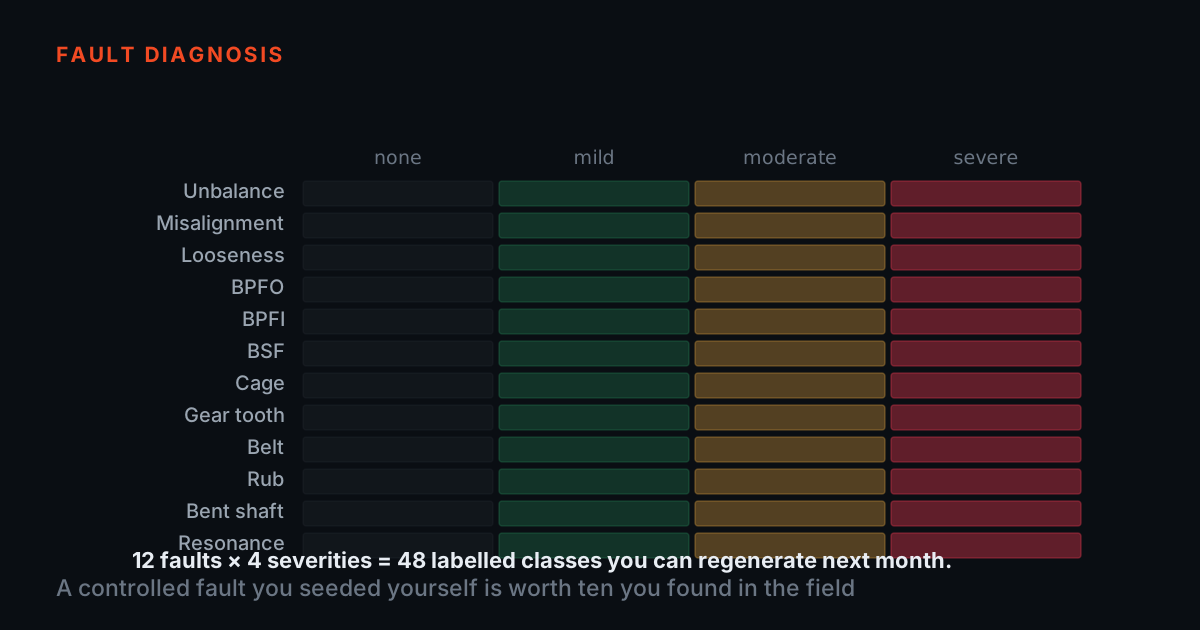
It also pairs naturally with hardware. A TMFSS fault-simulation stand and a PhonoVibe DAQ turn the simulated faults from the courses into physical, seeded, repeatable ones — the same bearing tones the student raised on screen in Bearing & Gear Analysis 101, now measured on a spinning shaft, and available for project and dataset work afterwards. The primer supplies the concepts and the vocabulary; the rig supplies the physics; neither pretends to replace the other.
TIERA instruments that do this work.
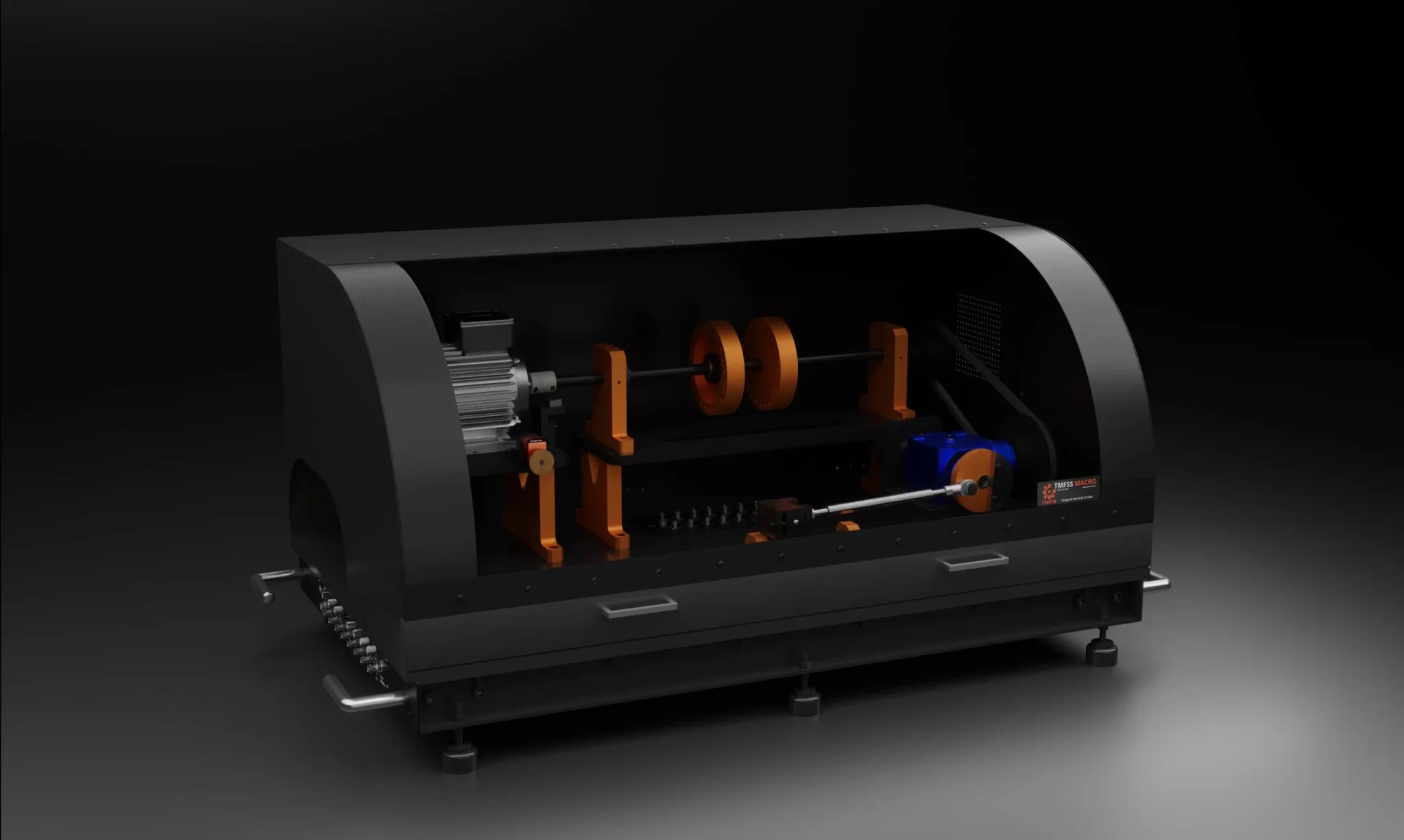
TMFSS — Machinery Fault Signature Simulator
The primer stays free — this is what a plant or university adds for a hands-on lab: the on-screen faults become physical, seeded, repeatable ones.
- Faults (Macro)
- 30+ base kit, extensible with add-on kits
- Faults (Mini)
- 7+ base kit
- Speed control
- VFD with WiFi software
- Tachometer
- Built-in, analog output
- Warranty
- 1 year; AMC available
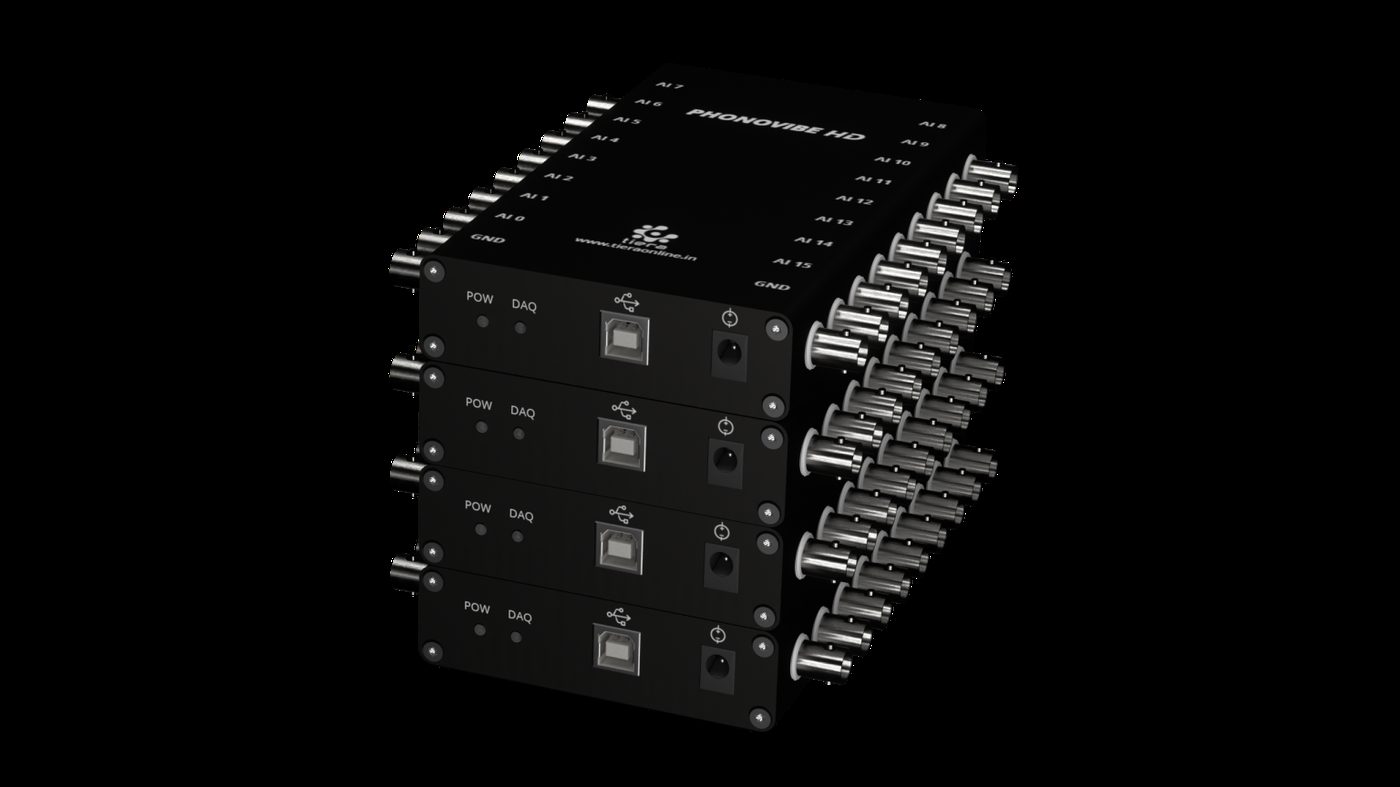
PhonoVibe Series — Sound & Vibration DAQ
The teaching lab's DAQ: students measure on a spinning shaft the same bearing tones they raised on screen in the free courses.
- Resolution
- 24-bit ADC, simultaneous sampling on every input
- Channels
- 2 / 4 / 8 / 16 (D / Q / O / HD)
- Eco X bundle
- 4-ch DAQ + 20 N shaker + 150 W amplifier + sensor starter pack
- Software
- Bundled with TVIB TSAP 201
Training Kits
Desktop-format rigs for classrooms where a full simulator will not fit — bearing-fault, balancing, and modal benches mapped to Cat I / Cat II lessons.
- Form factor
- Desk-mounted, 600 × 400 mm footprint
- Rigs
- Bearing-fault, balancing, and cantilever-beam modal
- Pairs with
- PhonoVibe Eco X + TVIB TSAP 201
- Warranty
- 2 years
From the TIERA store
The kit for this job
What we would actually put in front of someone doing the measurement this post describes — not the whole catalogue.
- Training KitsCompact, classroom-friendly hardware bundles that pair with TCAT Cat I / Cat II syllabi — bearing-fault rigs, balancing benches, and structural-modal demonstrators. Designed to fit a 6-ft table.Request priceView →
- Machinery Fault Signature Simulator | TMFSS MINIThe TMFSS Mini is Tiera’s compact yet powerful machinery fault simulator designed to provide hands-on learning and experimentation in fault diagnosis and vibration analysis. Ideal for educational institutions, research labs, and professionals, the TMFSS Mini enables users to simulate real-world machinery faults in a controlled environment.Request priceView →
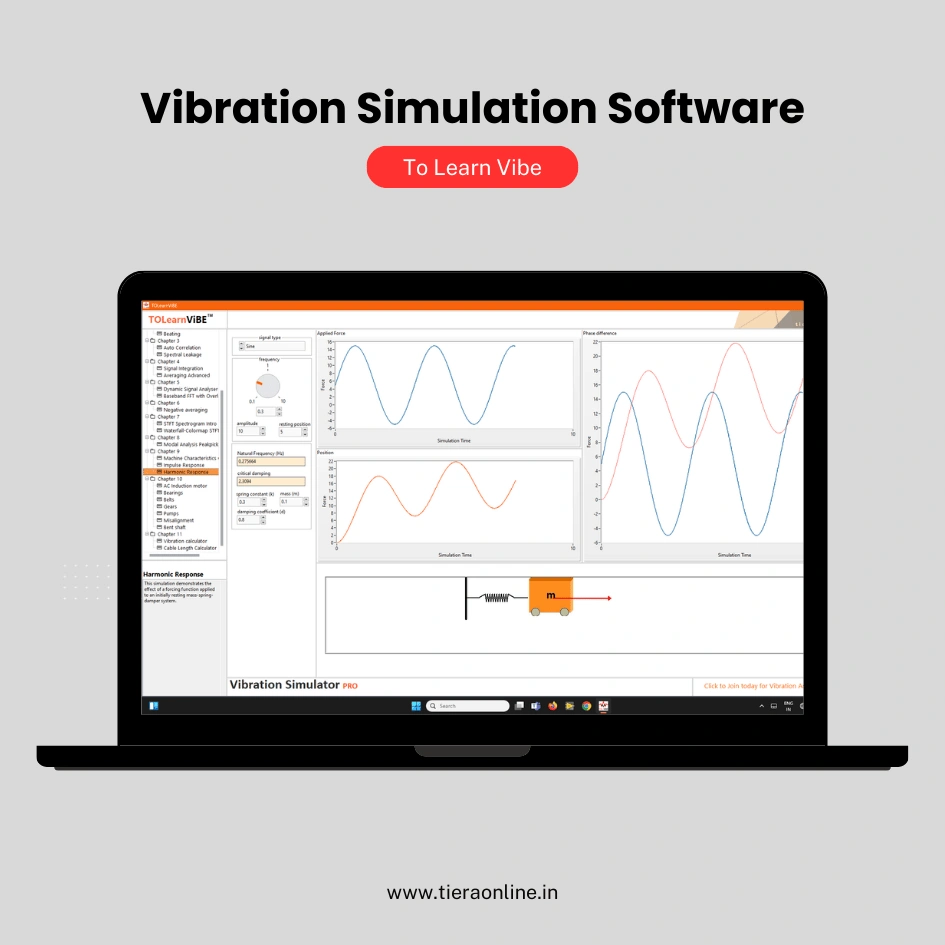 To Learn Vibe -Vibration Simulation Software Standard (Yearly Subscription)For comprehensive vibration analysis training, start with our To Learn Vibe software. Covering everything from basic to advanced vibration concepts, this software is designed to kickstart your career and enhance your expertise. Perfect for mastering fundamental and advanced vibration analysis, To Learn Vibe equips you with the knowledge and skills needed to excel in the field of vibration engineering.₹57,600View →
Use cases
Where this shows up in the field
The first step is free and starts today; the ladder is real when you want more.
There is no enrolment form to negotiate and nothing to buy first: TIERA 101 is live at 101.tieraonline.in — pick any track, start any course, and the certificates and verifiable badges are part of the free programme.
When the free primer has done its job, the next rungs are concrete. For a teaching or training lab, a TMFSS fault-simulation stand plus a PhonoVibe DAQ turns the on-screen faults into physical, repeatable experiments. For the formal credential, TCAT is TIERA's Category I–IV analyst training with proctored examinations — the formal, proctored path TIERA 101 is honest about not being.
- TIERA 101 — 10 free courses, 3 tracks, verifiable badges at certify.tieraonline.in
- TMFSS + PhonoVibe — seeded-fault hardware for a real teaching lab (/products/tmfss, /products/phonovibe)
- TCAT — formal Cat I–IV analyst training with proctored exams at exams.tieraonline.in
Where this sits on the TIERA learning ladder.
The theory behind this article is covered free, in full, by the TIERA 101 primers: Vibration 101 (Foundations), Measurement Setup 101, Balancing & Alignment 101. They are self-paced, interactive, and end in an exam and a certificate.
TIERA 101 is the free, ungated primer; TCAT adds what a primer cannot — formal Cat I–IV analyst training with proctored examinations at exams.tieraonline.in and a credential built for hiring managers, not just curiosity.
TIERA 101 is a free introductory primer, not an accredited ISO certification, and its hours do not count towards the formal training ISO 18436 requires.