
Why Your Peak Is the Wrong Height: Windows, Leakage and the Honest Amplitude
The FFT quietly assumes your record repeats forever — and when a tone doesn't fit the record, its peak drops and smears. A visual walk through leakage, scalloping and coherent gain, with a live comparator: pick a window, slide the tone off a bin, and watch the measured amplitude lie or hold.
The FFT assumes your record repeats — your machine never agreed to that
- The smear you see is not the machine. When a tone does not complete whole cycles in the record, the spliced copies leave a step at every seam, and that invented step is broadband.
- So leakage shows up twice over: the peak is shorter than the truth and it sits on a raised skirt.
An FFT does not analyse the signal; it analyses the finite record you captured, treated as if it repeated end to end forever. If the tone completes a whole number of cycles inside the record — its frequency lands exactly on a bin — the imaginary copies join seamlessly and all of its energy stacks into one line. Clean, tall, correct.
Machine frequencies do not consult your bin grid. A shaft at 2,987 RPM instead of 3,000 puts 1x a fraction of a bin off centre, and now the spliced copies do not meet: the FFT sees a step at every seam that the machine never produced. A step is broadband, so its energy smears across neighbouring bins — that smear is spectral leakage, and the visible symptoms are a shorter peak with a raised skirt.
Windows: taper the seam, pay in width
- You pay for a window twice: in amplitude, which the analyser has to correct using the window's coherent gain, and in peak width, which is resolution you no longer have.
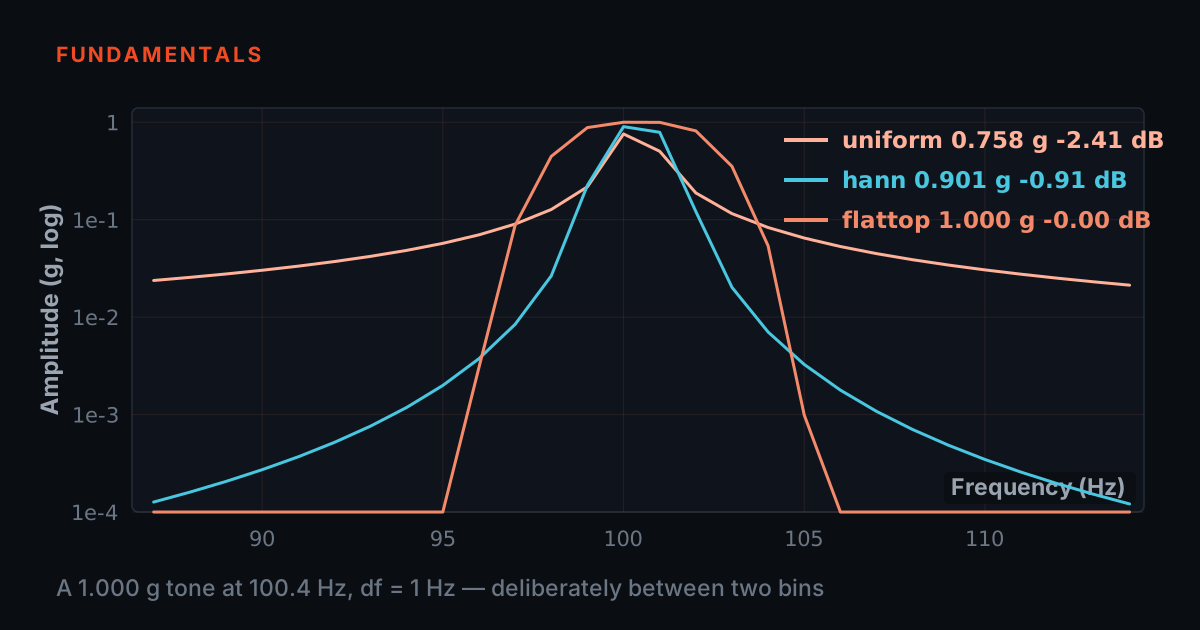
- Rectangular is the narrowest and the worst the moment a tone sits off-bin; Hann is the sensible general-purpose default; flat-top reads the right height anywhere between bins and is about four times wider than rectangular.
A window is a shaped multiplier applied to the record so both ends fade towards zero. With no ends to mismatch, the splice discontinuity disappears and leakage collapses. Nothing is free: tapering throws away signal — the average value of the window, its coherent gain, tells you how much (Hann keeps 0.500 of the amplitude, flat-top just 0.216) — and every analyser must divide by that number or every peak reads low. It also widens the peak, because a shorter effective record means coarser frequency discrimination.
The three characters worth knowing: rectangular (no window) has the narrowest peak but behaves worst the moment a tone sits off-bin; Hann tapers smoothly and is the sensible general-purpose default; flat-top deliberately flattens the tip of its response so a tone reads the correct height anywhere between bins — at the price of a peak roughly four times wider than rectangular's.
Scalloping: the picket-fence error
Even after leakage is tamed there is a second, sneakier error. The FFT only reports amplitude at bin centres — you view the spectrum through the pickets of a fence. When a tone sits exactly between two bins, neither bin sits on the true peak, and the tallest one under-reads: rectangular by 3.9 dB (a 36% amplitude loss), Hann by 1.4 dB (15%), flat-top by less than 0.01 dB. That is scalloping loss, and it is why flat-top exists at all.
The damage is worst in trending and pass/fail work. Let line speed drift a few RPM between surveys and the 1x tone slides across a bin: with a Hann window the logged amplitude can swing 15% while nothing on the machine changed. That is a fake trend — or a pass/fail limit that effectively moves with speed.
Try it: the window comparator
The instrument below is real, not an illustration: it windows a 256-sample record (1,024 S/s, so bins sit 4 Hz apart), evaluates the DFT directly, and corrects amplitude by each window's coherent gain — rectangular 1.0, Hann 0.5, flat-top 0.2156. The bars are what an analyser reports at its bins; the faint curve underneath is the leakage skirt that lives between them. The true signal is always exactly 1.000 g.
Start at 40 Hz — exactly on bin 10 — and note that all three windows read 1.000 g. Now slide to 42 Hz, dead-centre between bins, and switch windows: rectangular collapses to about 0.65 g with a skirt smeared across the whole span, Hann dips to about 0.85 g, and flat-top holds within a fraction of a percent — while its −3 dB width readout shows what that honesty costs. Rectangular lands a shade above the 0.637 g the textbook worst case predicts, and the two bins either side of the tone do not read quite the same height, because at bin 10 the tone's own negative-frequency image is still close enough to leak back in and add to one bin while subtracting from the other. That is not a flaw in the bench — it is the rectangular window's leakage arriving from the other end of the spectrum, and no other window on the panel has it.
Choosing on purpose: a representative end-of-line case
- Flat-top when the question is how big. Hann when the question is what and where. Rectangular only for transients and pseudo-random signals that already fit the record.
- Which makes a window a per-measurement choice, not a lifetime setting: the same cell can check amplitude limits on flat-top and diagnose the failures on Hann.
A representative example, not a specific customer: an end-of-line test cell checks motors against amplitude limits at 1x and 2x. Line voltage and load vary slightly, so run speed wanders a few RPM from unit to unit — which means the 1x tone wanders across a bin. With a Hann window, physics says identical motors can read up to 15% apart depending on where their tone lands; the pass/fail threshold is effectively a band, not a line. Switching the amplitude-check measurement to flat-top pins the reading to within a fraction of a percent of the true value, so the limit means what it says.
The same cell keeps Hann for diagnosis. When a unit fails and someone needs to separate a 2x line from a nearby sideband, flat-top's broad peak would merge them; Hann's narrower peak — or a longer record for finer bins — resolves them. That is the working rule this post is really about: flat-top when the question is 'how big?', Hann when the question is 'what and where?', rectangular only for transients and pseudo-random signals that already fit the record. A window is a per-measurement choice, not a lifetime setting.
Where to learn this properly
Windowing sits in a chain with sampling and resolution — if the front end aliases, no window can save the spectrum (that story is in our sample-rate and anti-aliasing explainer). The theory behind both — DFT assumptions, leakage, window figures of merit — is covered in TIERA's free Signal Processing 101 primer at 101.tieraonline.in. The primers are free introductory courses for onboarding and refreshing fundamentals, not accredited ISO certifications.
For formal, assessed competence in vibration analysis, TIERA runs the TCAT programme — details on the services page at /services — with proctored examinations at exams.tieraonline.in. A sensible path: the primer first, then an afternoon with a signal generator and the comparator habit above on a real analyser, then the formal programme when certification matters.
TIERA instruments that do this work.
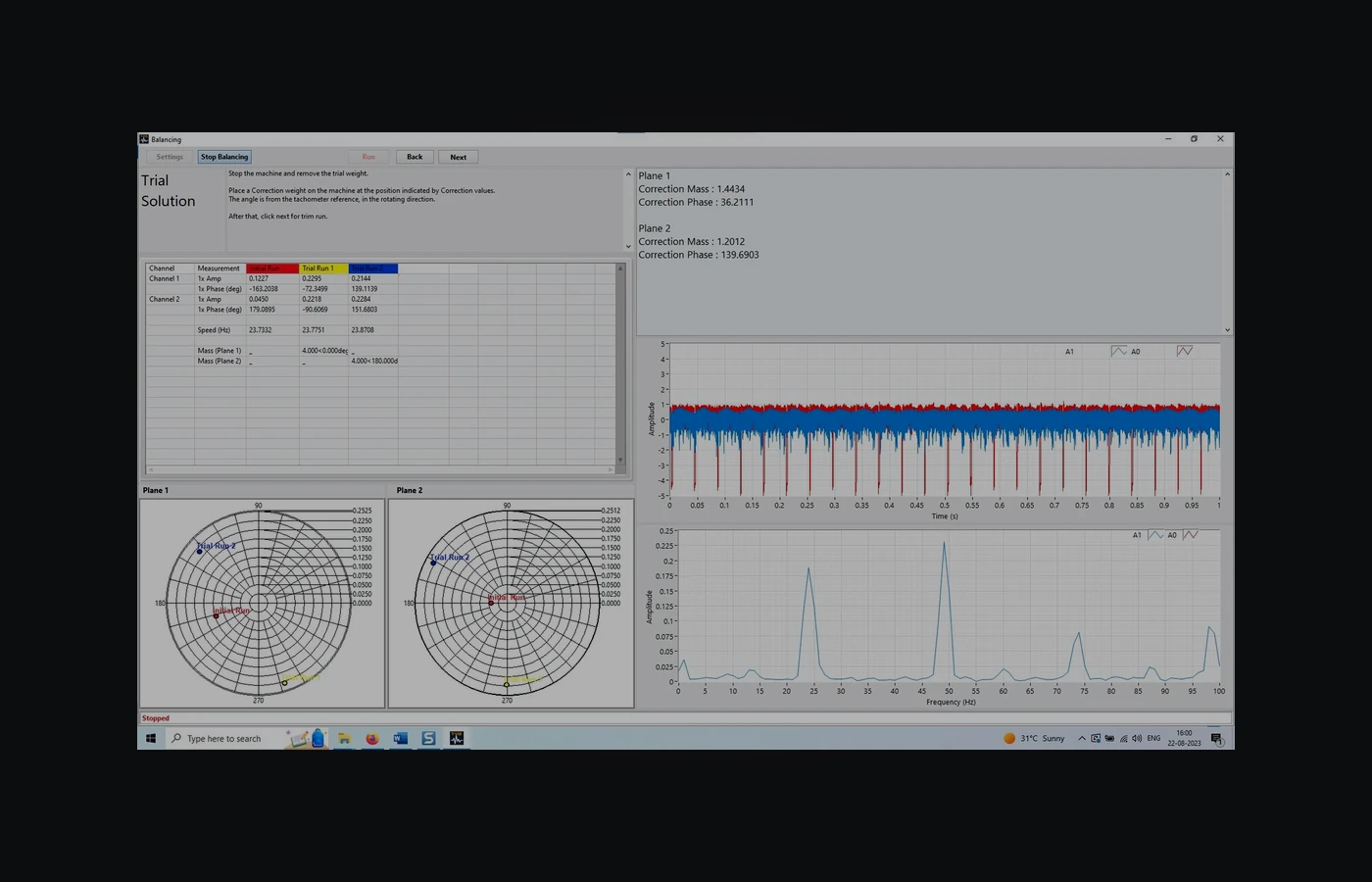
TVIB — Sound & Vibration Analysis Software
The window is one click, not one commitment: selectable windowing with exponential, linear and peak-hold averaging, and FFT sizes fine enough that scalloping and resolution stop fighting each other.
- FFT size
- Up to 102,400 points
- Averaging
- Exponential, linear, peak hold — selectable windowing
- Cursors
- Harmonic, band and sideband, in time and frequency
- Scaling
- Independent per-channel calibration; linear, log and dB
- Trial
- 14-day fully-unlocked evaluation licence
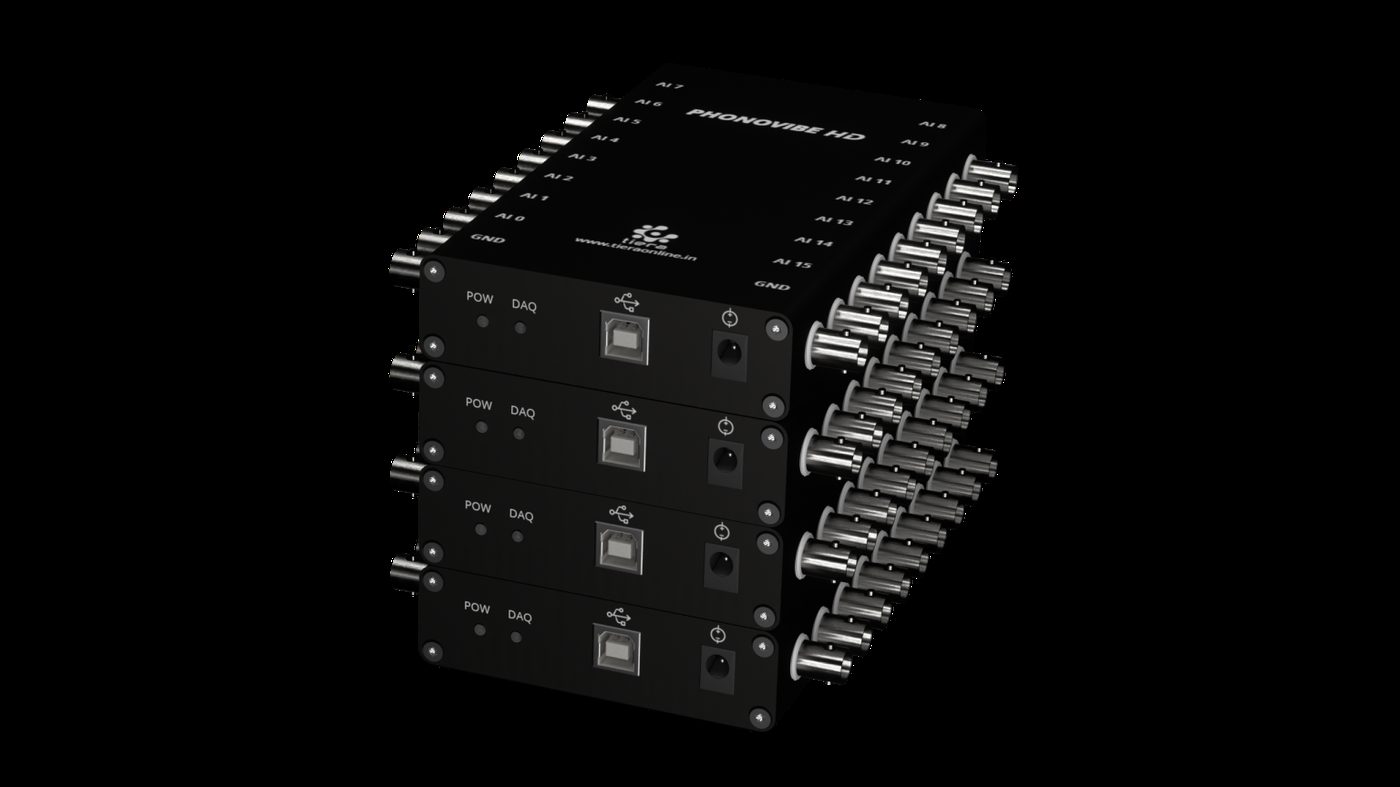
PhonoVibe Series — Sound & Vibration DAQ
The samples the window multiplies have to be worth trusting first: 24-bit simultaneous sampling with IEPE power and TEDS, and every unit ships with a TSAP 201 licence.
- ADC resolution
- 24-bit, simultaneous sampling
- Channels
- 2, 4, 8 or 16 (BNC)
- Sensor power
- 24 V, 4 mA (IEPE/ICP/CCLD)
- TEDS
- Supported
- Software
- TVIB TSAP 201 bundled, perpetual licence
From the TIERA store
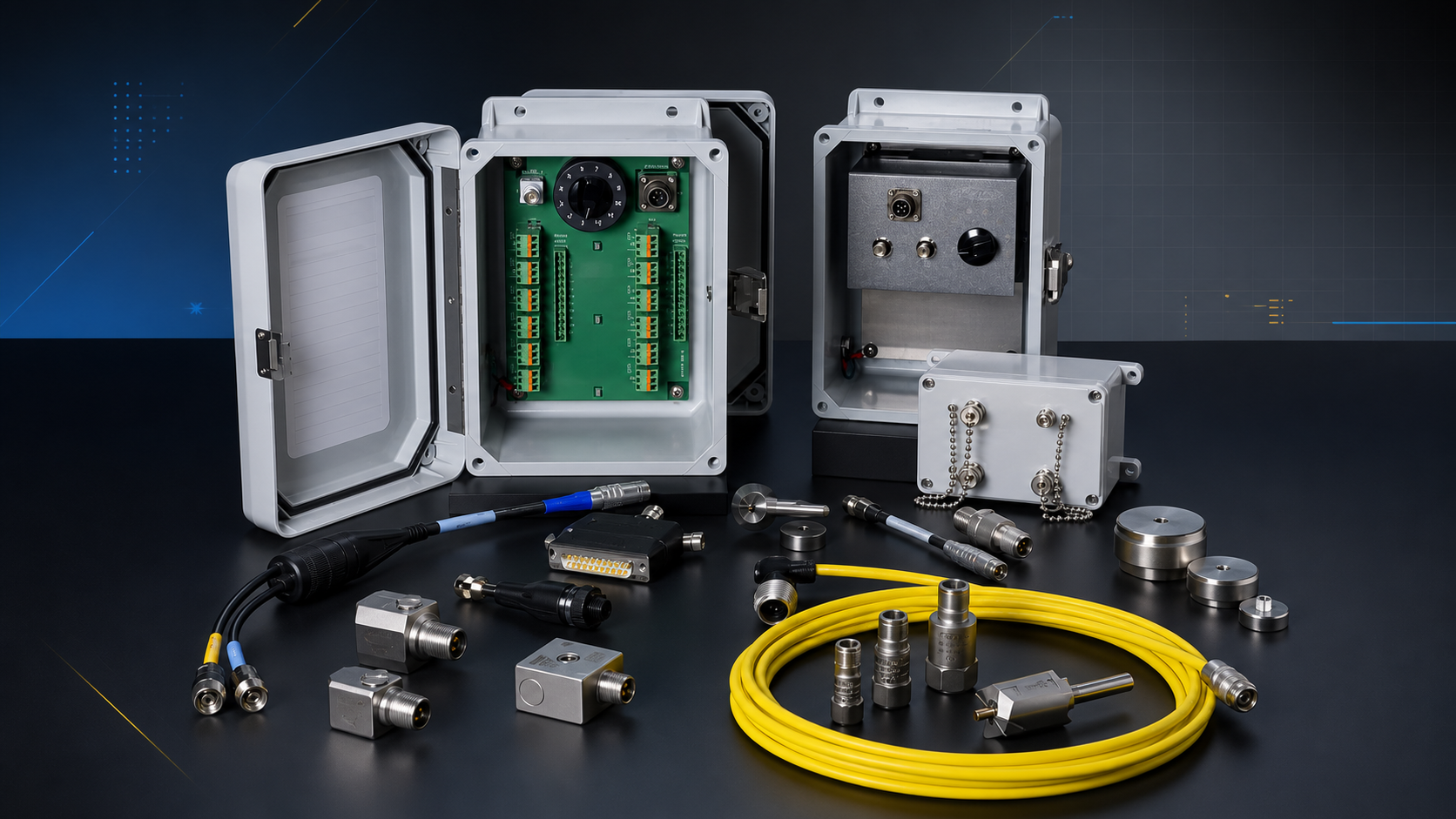
The kit for this job
What we would actually put in front of someone doing the measurement this post describes — not the whole catalogue.
Use cases
Where this shows up in the field
An analyser where the window is one click, not one commitment
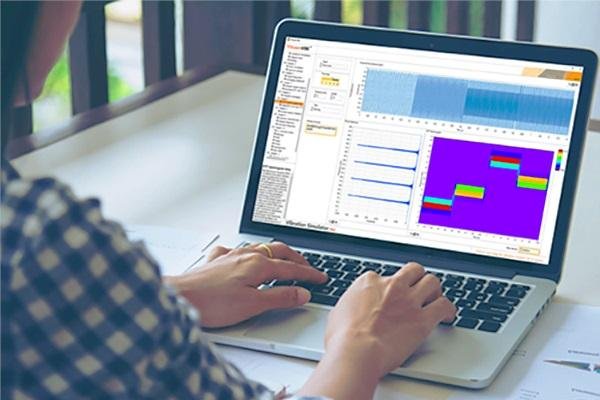
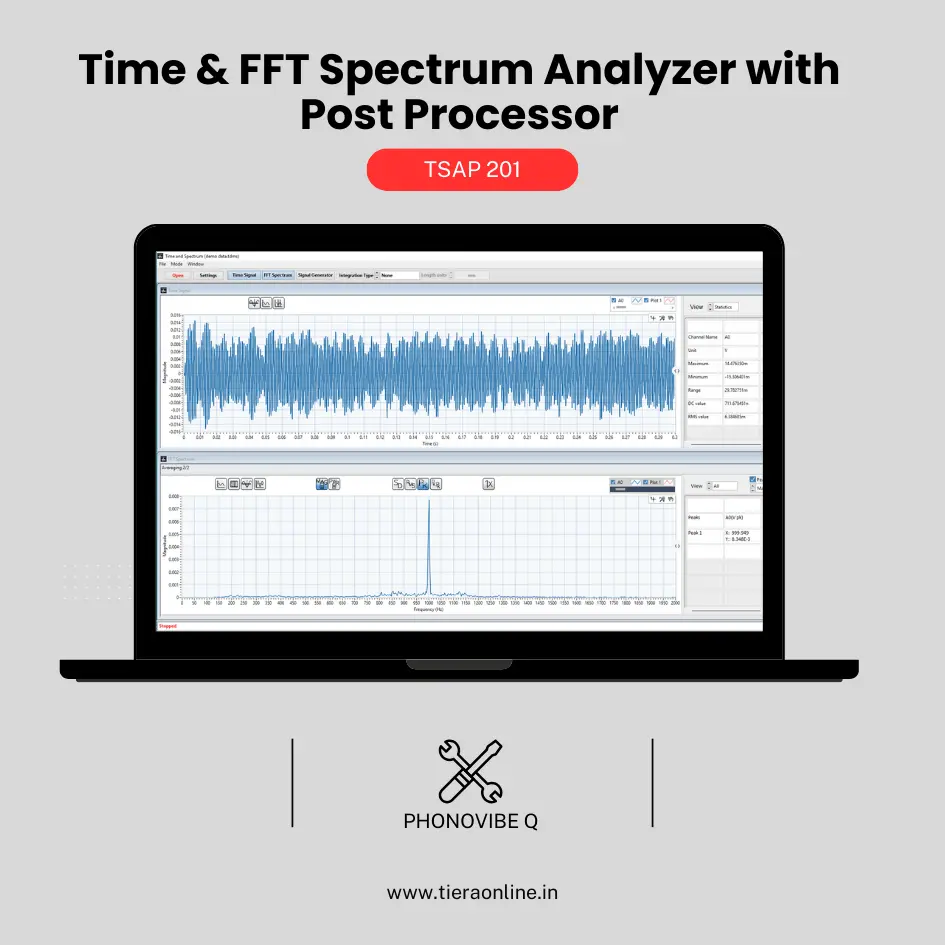
Everything in this post assumes your analyser lets you choose — and corrects honestly for the choice. TVIB's TSAP 201 base module does both: selectable windowing alongside exponential, linear and peak-hold averaging, calibrated per-channel scaling so amplitudes are in real units, and FFT sizes up to 102,400 points when you need bins fine enough that scalloping and resolution stop fighting each other. Harmonic, band and sideband cursors then do the 'what and where' work on the narrow-window view.
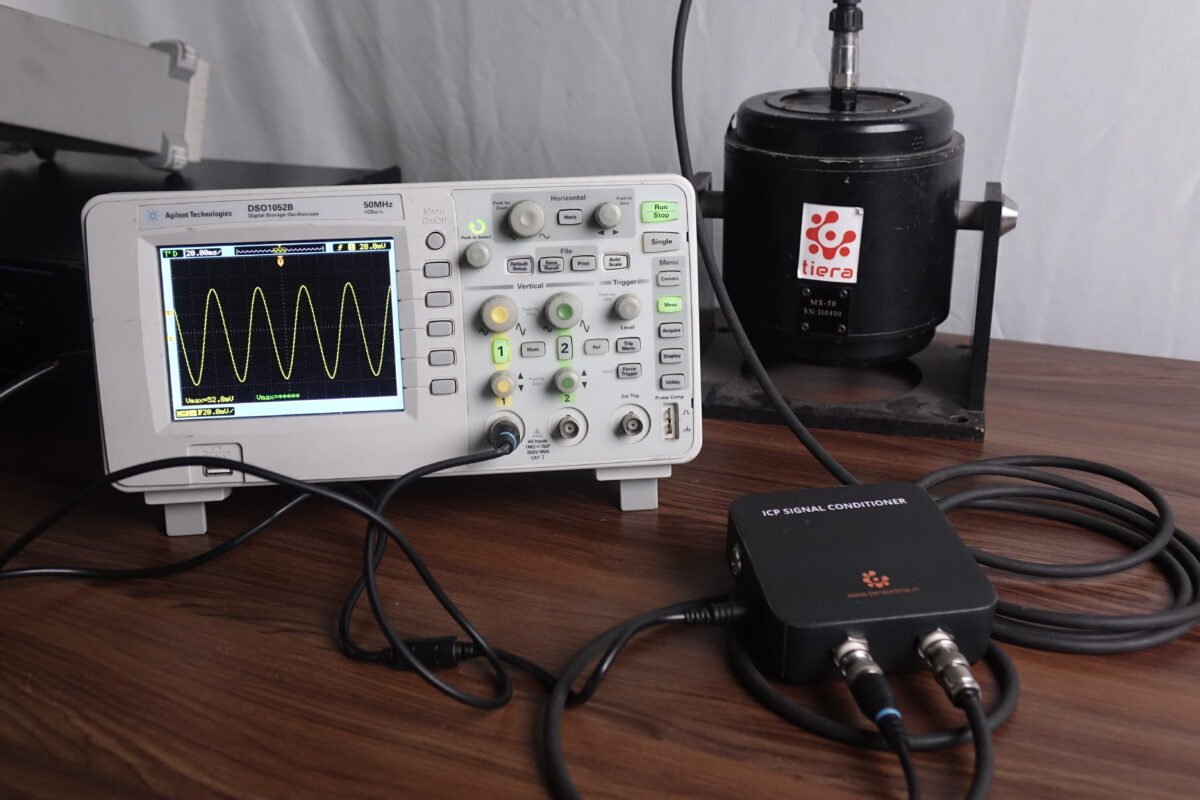
The front end matters just as much: PhonoVibe DAQs (2 to 16 channels) sample every input simultaneously at 24 bits with built-in IEPE sensor power and TEDS recognition, and every unit ships with a TSAP 201 licence — so the samples the window multiplies are worth trusting in the first place.
- TVIB TSAP 201 — narrowband FFT with selectable windows and exponential / linear / peak-hold averaging
- Up to 102,400-point FFT with harmonic, band and sideband cursors for close-line diagnosis
- PhonoVibe DAQs — 24-bit, simultaneous sampling, IEPE power, TEDS; TSAP 201 bundled
- 14-day fully-unlocked TVIB trial available to test your own signals
Where this sits on the TIERA learning ladder.
The theory behind this article is covered free, in full, by the TIERA 101 primers: Signal Processing 101. They are self-paced, interactive, and end in an exam and a certificate.
The free Signal Processing 101 primer at 101.tieraonline.in teaches the DFT, leakage and windowing theory; the formal TCAT programme (see /services) adds structured coursework and proctored examinations at exams.tieraonline.in for teams that need assessed, certificated competence.
TIERA 101 is a free introductory primer, not an accredited ISO certification, and its hours do not count towards the formal training ISO 18436 requires.