
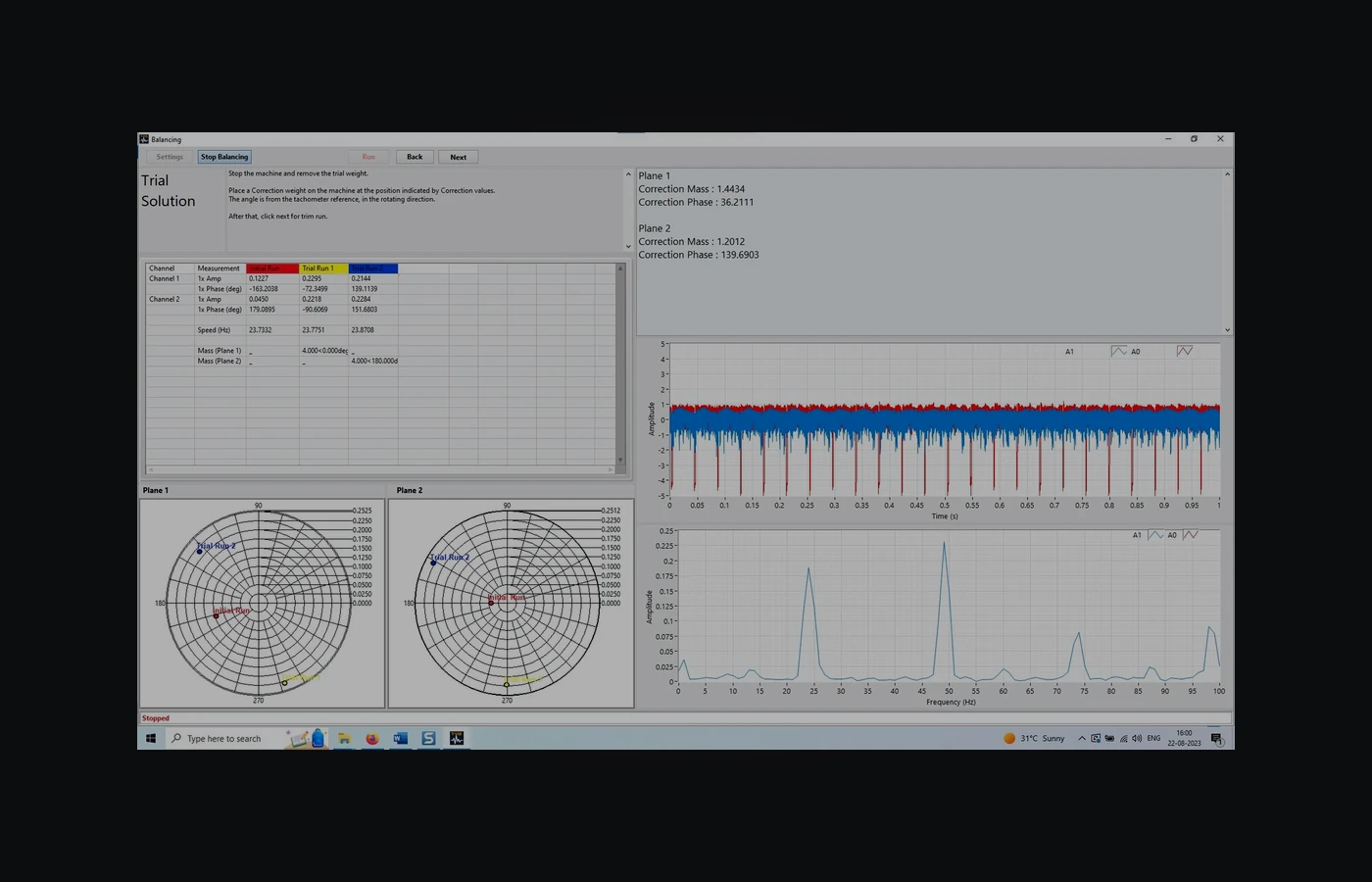
Every rotating machine tells you how it is doing through the way it vibrates. Vibration 101 is where that story starts. Before any fancy diagnosis, you need to be fluent in the basics: what the wiggling trace on the screen actually represents, how big it is, how fast it repeats, and how those numbers relate to the machine turning in front of you. This course builds that fluency from zero, assuming no prior background beyond a willingness to look at a plot and think about what it means.
You will learn to read a time waveform and its spectrum, to describe amplitude with the right measure — peak, peak-to-peak, RMS, true-peak or crest factor — and to move comfortably between Hz, CPM/RPM and orders of running speed. You will understand phase, and the displacement–velocity–acceleration triad that decides which sensor and units suit a given frequency range. Finally you will put a number on “how bad is it” using ISO 20816 severity bands. It is the foundation every other TIERA 101 course is built on — start here.